

At Funda, we believe great product development starts with understanding the problem, not jumping straight to the solution. Product Manager Marc Jutten shares how a seemingly simple request from the new-build market led to a much broader product discovery – and a solution that better serves project developers, real estate agents and consumers alike.
A simple request... or so we thought
When Team ‘Nieuwbouw’ started a little over a year ago, we were all new to the world of new-build property development in our own way. Some of us came from different markets. Others had been at Funda for years, but mostly worked on existing homes. And while Funda has helped people find homes for more than 25 years, nieuwbouw quickly showed us that it has its own dynamics.
One of the first requests we got from the market sounded simple: ‘Just add an option to list new-build homes with a price range.’ At first glance, it felt like a minor change. Add another pricing option, show it on Funda, and move on.
But good product work rarely starts with building the requested solution. It starts with understanding the problem behind it.
See also: Hackathon 2026: what we built when we stepped off the roadmap
Understanding the market before building
So we went into discovery mode. We visited real estate agents across the Netherlands and spent hours learning how new-build projects move from preparation to sale. We learned what information agents have available at different moments, what they can communicate when, and how much depends on setting the right price before sales start.
That is where one important difference became clear. In the existing-build market, the asking price is often the start of a negotiation. When demand is high, buyers can bid above it; when demand drops, buyers will start low. In the new-build market, the advertised price is almost always the final price.
That makes pricing before sales start critical. Set the price too low, and value may be left on the table. Set it too high, and demand can fade before the project has properly started.
Looking beyond the original request
So the question changed. It was no longer: ‘Can we add price ranges?’, but: ‘How can Funda help the new-build market communicate pricing earlier and more flexibly, while still giving consumers clear and trustworthy information?’
That last part mattered a lot, because we also care deeply about the consumer experience. More pricing flexibility could also mean more complexity. Would people understand why one home has a starting price, another has a range, and another has no price yet? Would that create confusion or reduce trust?
But the alternative also had a clear downside. Without pricing flexibility, many new-build homes would only appear on Funda once sales had officially started. For consumers, that would mean discovering a project late in the process, sometimes when the most important decisions have already been made or the first registration moment has passed.
So we needed to understand the trade-off properly. We spoke with agents, looked at the market, and learned that this pricing uncertainty is already a normal part of the nieuwbouw journey. Consumers who are interested in new-build homes are used to early-stage information becoming more concrete over time. The benefit of discovering a project earlier outweighed the added complexity, as long as we presented the pricing information clearly.
See also: Legacy migration: how we rebuilt the listing detail page with a small team
Building the right solution
We also learned that price ranges were only part of the answer. Sometimes the object price is not known yet. Sometimes only a starting price is available. Sometimes a range is used to test interest before sales start. And sometimes a project developer prefers not to share pricing yet at all. The market did not need one extra field; it needed full pricing flexibility.
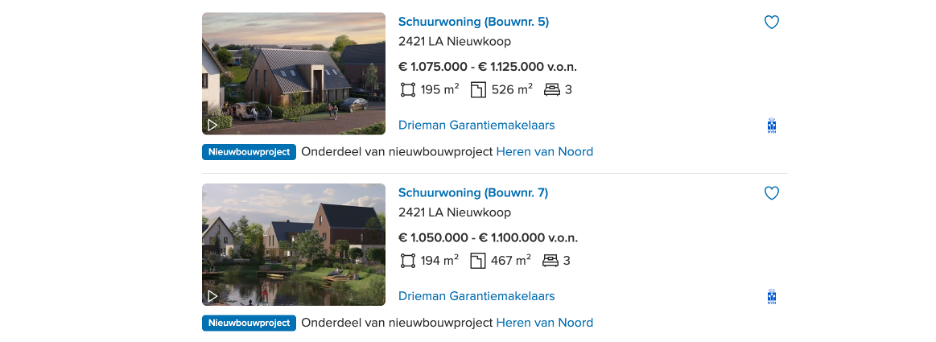
That is what we launched: the option to show no price, a starting-from price, or a price range on object level before sales start. Since launch, we have seen appreciation from the market. We have also already seen the different pricing options being used in practice, which confirms what we learned during the discovery phase: that there was not one pricing situation to support, but several.
The product lesson
This is what I love about the product craft. A request that sounds small can hide a much bigger market problem. And when you take the time to understand the market, the users, the incentives and the process, you build something better than what was originally asked.
This was never just about adding a price range. It was about learning how new-build works, understanding what truly matters to agents, project developers and consumers, and building a solution that helps the market move forward. Sometimes the best product work starts with a small request.
Do you have a burning question for Marc after reading his blog? Feel free to reach out to him via email.